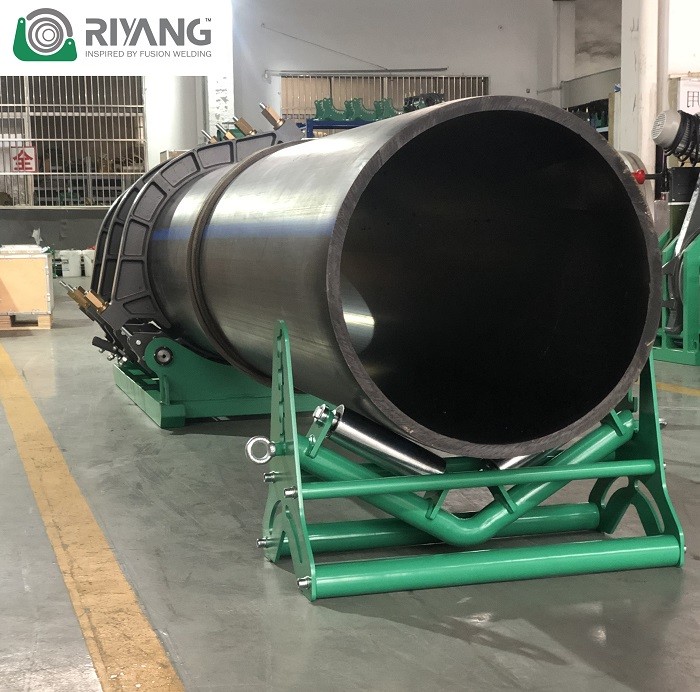
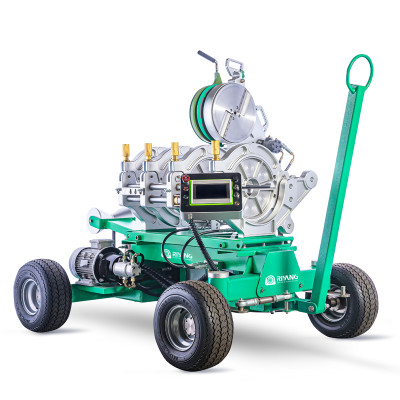
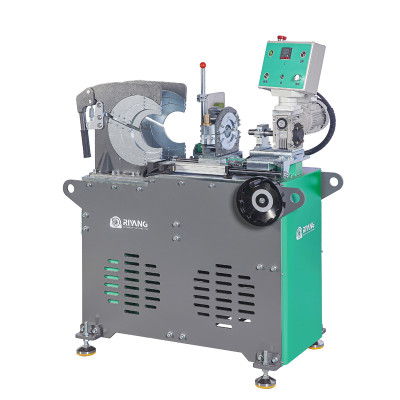
Choosing the correct pipe fusion machine size depends primarily on three factors: the pipe outer diameter (OD), the Standard Dimension Ratio (SDR) that determines wall thickness, and the project type. The machine must match the pipe OD range, generate sufficient fusion force for the wall thickness, and suit the jobsite configuration. This guide breaks down each selection criterion with practical references.
1. Pipe OD vs Machine Nominal Range
The first and most straightforward sizing factor is pipe outer diameter. Every butt fusion machine is rated for a specific OD range — for example, 63–250 mm, 200–500 mm, or 630–1200 mm. The machine's clamping frame and jaw inserts determine the minimum and maximum diameters it can securely hold.
When selecting, consider not only your current project's pipe sizes but also potential future work. A machine rated for 200–500 mm can handle many municipal water and gas distribution projects, while a 630–1200 mm unit is necessary for trunk mains and industrial transfer lines. Oversizing the machine for occasional small-diameter work is uncommon, but under-sizing leads to costly project delays or the need to rent additional equipment.
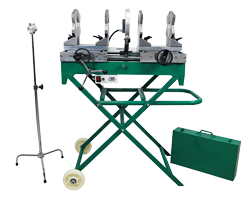
Manufacturers typically publish a nominal clamping range. Within that range, different insert sets may be required for different pipe diameter sub-ranges, so confirm insert compatibility before purchase. For detailed machine specifications across all diameter ranges, refer to Riyang's butt fusion machine catalog.
2. Why SDR Changes Fusion Force and Cooling Demands
SDR (Standard Dimension Ratio) is the ratio of pipe OD to minimum wall thickness. A lower SDR number means a thicker wall — for instance, SDR 11 pipe has a significantly thicker wall than SDR 26 pipe of the same OD. This directly affects the fusion force requirement: thicker walls demand higher fusion pressure to achieve the specified interfacial pressure during the heating and fusion phases.
The fusion force is calculated as interfacial pressure multiplied by the pipe end cross-sectional area. For a given OD, an SDR 11 pipe has roughly double the end area of an SDR 26 pipe, meaning double the hydraulic force is needed. If the machine's hydraulic cylinder cannot generate this force at its rated working pressure, the joint cannot be made to specification.
Cooling time also increases with wall thickness. A thicker SDR pipe retains heat longer, requiring extended cooling under pressure before the joint can be removed from the machine. This directly affects jobsite productivity — a machine that cannot maintain stable pressure through the full cooling cycle will produce unreliable joints.
3. Small-, Medium- and Large-Diameter Machine Classes
Fusion machines are broadly grouped into three size classes based on pipe diameter capability:
| Class | Typical OD Range | Common Applications | Typical Fusion Force |
|---|
| Small | 40–160 mm | Service lines, irrigation laterals, small gas distribution | Up to ~20 kN |
| Medium | 250–630 mm | Water mains, gas distribution mains, mining slurry lines | ~20–120 kN |
| Large | 400–2000 mm | Trunk water mains, industrial transfer, outfall pipelines | ~120–800+ kN |
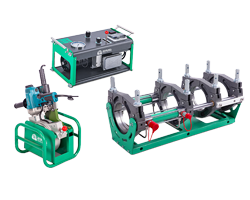
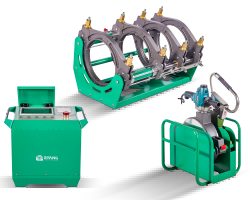
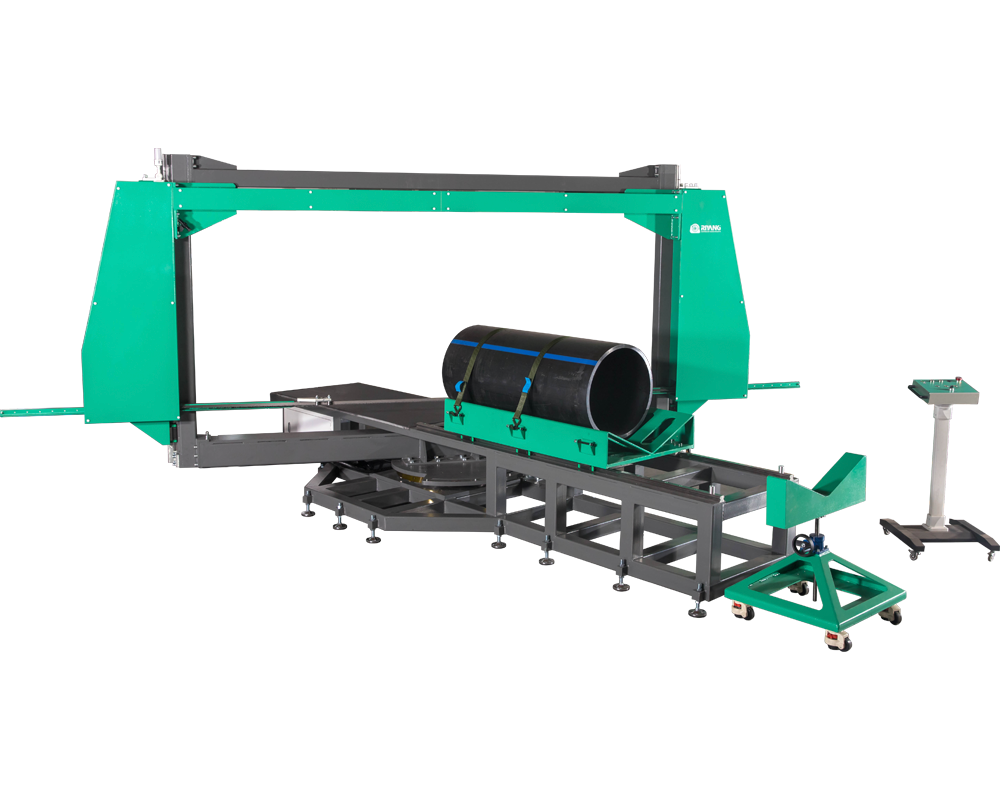
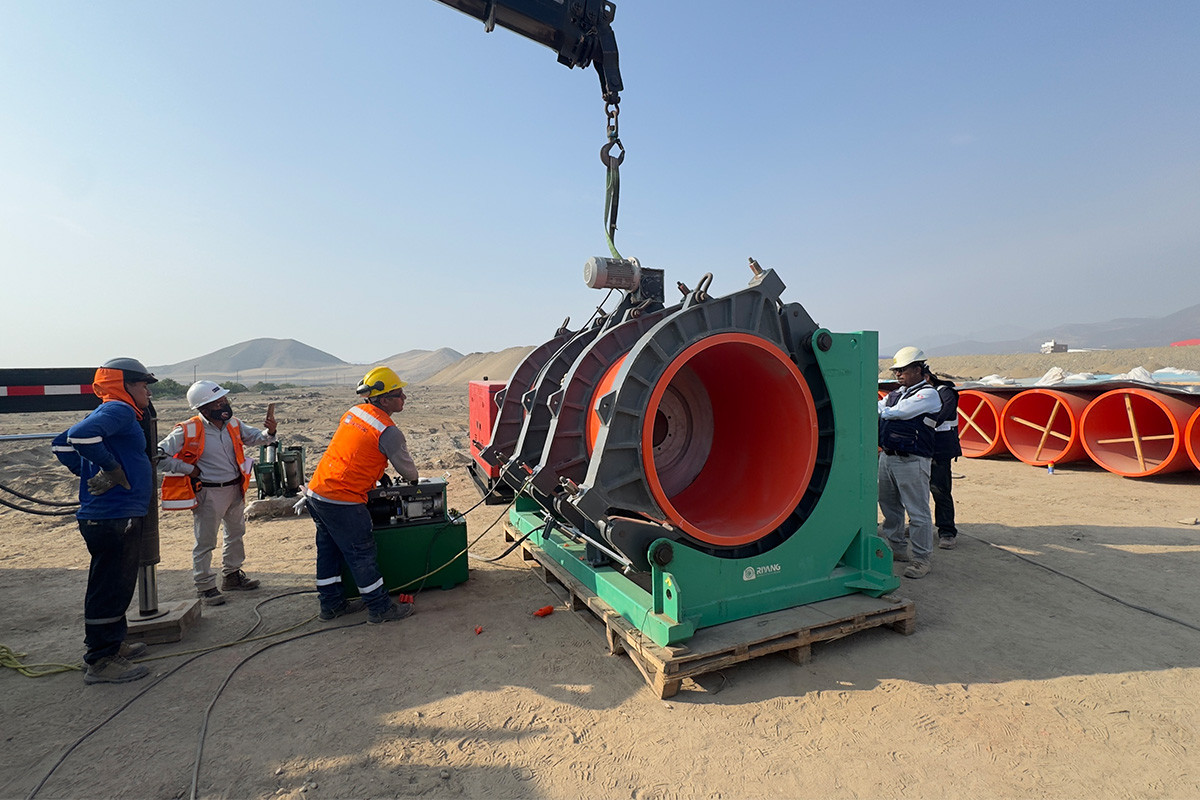
Small pipe fusion machines are often manual or semi-automatic and suited to workshop or light field use. Medium machines are the workhorses of pipeline contracting, available in manual, hydraulic, and automatic configurations. Large machines are almost exclusively hydraulic or CNC-controlled and require dedicated handling equipment, power supply planning, and operator training.
Selecting the right class also depends on wall thickness at the upper end of each range. A 500 mm SDR 9 pipe may require a machine normally rated for 630 mm at SDR 17, because the fusion force demand scales with cross-sectional area, not just OD. For help matching machine class to specific project parameters, consult the Riyang selection guide.
4. Manual, Hydraulic, CNC and Mobile Configurations
Beyond diameter capability, the machine's control configuration directly affects operator dependency, weld repeatability, and suitability for different project types:
- Manual machines use hand wheels or levers to control carriage movement and fusion pressure. They are simple, lower-cost, and well-suited to smaller diameters (up to ~160 mm) and lower production rates. Operator skill has a large influence on joint quality.
- Hydraulic machines use a powered hydraulic power unit (HPU) driving a cylinder for carriage movement and pressure control. Pressure can be set and monitored via gauges or digital readouts. They are the standard for medium and large diameters, offering greater consistency and reduced operator fatigue.
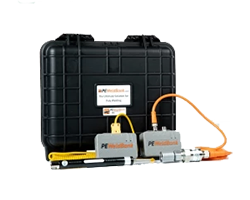
- CNC/automatic machines add programmable logic controllers that guide the operator through each fusion phase, monitor parameters in real time, and log data for each joint. They improve traceability and are increasingly specified for gas and nuclear applications.
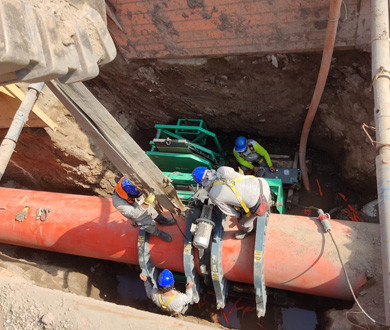
- Mobile configurations include tracked self-propelled units, trailer-mounted machines, and compact in-ditch frames. Mobility selection depends on whether the machine needs to travel along a pipeline route or operate in a fixed yard.
The choice of control level should match the project's quality-assurance requirements and the available operator skill level. Higher automation reduces the risk of human error but increases machine cost and maintenance complexity.
5. Power Supply, Inserts and Accessories
Machine sizing goes beyond the main frame. Several supporting components determine whether a machine can actually operate at a given site:
Power supply: The heater plate, facer, and hydraulic power unit each have specific voltage and phase requirements. Large heater plates on machines above 450 mm may require three-phase power. On remote sites, generator sizing must account for the combined inrush current of the heater, facer motor, and HPU. Undersized generators cause voltage drops that affect heater temperature stability and facer motor torque.
Reducer inserts: To fuse pipes of different diameters, reducing inserts adapt the main clamp jaws to smaller pipe ODs. Confirm that the insert range covers all diameters and SDR combinations on the project. Inserts must maintain concentric alignment between pipes of different diameters.
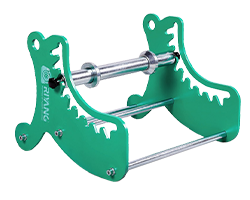
Pipe handling accessories: For machines above 315 mm, roller supports or pipe stands are essential to reduce drag pressure and prevent pipe-end misalignment. Without proper support, long pipe strings exert bending moments on the fusion joint during cooling, compromising quality. See Riyang's pipe roller support range for compatible options.
6. Selection Matrix by Project Type
Different industries impose different requirements on machine selection. The following matrix maps common project types to recommended machine configurations:
| Project Type | Typical OD Range | Recommended Control | Key Considerations |
|---|
| Water distribution | 90–630 mm | Hydraulic, data logging optional | Moderate pressure, long pipeline runs, multiple joints per day |
| Gas distribution | 63–400 mm | Hydraulic or CNC, data logging recommended | Strict traceability, operator qualification records, bead inspection |
| Mining slurry | 160–1200 mm | Hydraulic, high-force capable | Abrasion-resistant pipe grades, thick SDR, remote power supply |
| Industrial process | 90–2000 mm | CNC with full data logging | Multi-material (HDPE, PP, PVDF), chemical resistance, quality records |
| Irrigation | 63–500 mm | Manual or hydraulic | High joint count, field mobility, seasonal use patterns |
Project-specific procedures always take precedence over general recommendations. Gas projects, for example, may mandate CNC data logging and specific operator certifications regardless of pipe diameter. Consult the project specification and applicable standards before finalizing machine selection.
7. Buyer Checklist
Before finalizing a machine purchase or rental, work through these verification points:
- Pipe OD range: Does the machine's clamping range cover the smallest and largest pipe on the project? Have inserts for all required diameters been included?
- SDR and fusion force: At the project's thickest SDR and largest OD, can the hydraulic system deliver the required fusion pressure with adequate margin?
- Heater plate size and power: Does the heater plate match the maximum pipe diameter and SDR? Is on-site power sufficient for both heater and facer?
- Facer capability: Can the facer produce clean, parallel faces on both pipe ends within an acceptable changeover time?
- Mobility: Does the machine configuration (compact, rolling, trailer, tracked) suit the jobsite terrain and pipe-laying sequence?
- Data logging: Is traceability required, and if so, does the machine include or support a compatible data logger?
- Spare parts and service: Are consumable items (PTFE heater coatings, facer blades, hydraulic seals) readily available? Is local service support accessible?
- Training: Have operators been trained on the specific machine model and the project's approved welding procedure?
- Environmental conditions: Can the machine maintain heater temperature and hydraulic performance in expected ambient temperatures, wind, and humidity?
8. Frequently Asked Questions
Can I use one machine for all pipe sizes on a multi-diameter project?
Yes, if the machine's clamping range covers both the smallest and largest pipe ODs with appropriate reducer inserts. However, fusion force must also be adequate for the thickest SDR at the largest OD. Some projects use two machines: a small unit for laterals and a medium unit for mains.
What happens if the machine is too small for the required fusion force?
The joint will not achieve the specified interfacial pressure during the heating and fusion phases. This results in insufficient melt mixing, potential cold fusion defects, and joint failure under service pressure. A machine with inadequate force cannot produce a specification-compliant joint, regardless of operator skill.
How do I know the correct fusion pressure for my pipe?
Fusion pressure is calculated from the pipe OD, SDR, the machine's cylinder effective area, and the specified interfacial pressure (typically 0.15–0.18 MPa for PE). The machine manufacturer or the project's welding procedure specification (WPS) should provide the exact formula and values. Never estimate fusion pressure.
Is a CNC machine always better than a hydraulic machine?
Not necessarily. CNC machines provide superior traceability and guided operation, which is valuable for gas and nuclear projects. However, they are more expensive, require more maintenance, and may be over-specified for standard water or irrigation work where a well-maintained hydraulic machine with trained operators can produce equally sound joints.
Does ambient temperature affect machine size selection?
Yes. In very cold conditions, the heater plate may require longer warm-up and the cooling rate increases. Some fusion procedures specify extended heating times or wind shields. The machine must be able to maintain stable pressure throughout the extended cooling period. This is particularly relevant for large-diameter, thick-wall pipe in cold climates.
Key Takeaways
- Machine size selection starts with pipe OD range and must also account for SDR-driven fusion force requirements.
- Control configuration (manual, hydraulic, CNC) should match the project's quality assurance requirements, not just the pipe diameter.
- Power supply, reducer inserts, and pipe handling accessories are integral to machine sizing — they determine whether the machine can operate effectively on site.
- Industry-specific requirements for data logging, traceability, and operator qualification can override general machine selection guidelines.
- Always verify fusion force calculations against the project's approved welding procedure specification before committing to a machine.
- For expert guidance on machine selection, refer to Riyang's selection guide or contact the Riyang team for a project-specific recommendation.
References
- ISO 21307:2017 — Plastics pipes and fittings — Butt fusion jointing procedures for polyethylene (PE) piping systems
- ISO 12176-1:2017 — Plastics pipes and fittings — Equipment for fusion jointing polyethylene systems — Part 1: Butt fusion
- DVS 2207-1 — Welding of thermoplastics — Heated tool butt welding of pipes, pipeline components and sheets made of PE
- ASTM F2620 — Standard Practice for Heat Fusion Joining of Polyethylene Pipe and Fittings
- Riyang Butt Fusion Machine product range — Browse catalog